reflections of a barely millennial episcopal chaplain...
Showing posts with label Jesus. Show all posts

Sunday, March 13, 2016

Judas Icon of Wealth and Misogyny...

A woman has a container filled with something costly.

A man is on a path of sorrow and despair.

The woman seeks to open up her container and bring joy to a man whose path is sorrow.

Another man, in many ways the proverbial man, wishes to maintain his wealth and privilege so he seeks to control what the woman can do with her container and deny the sorrowful man joy.

This is the story of Jesus in the weeks before his crucifixion, this is the story of Mary wishing to see joy on the face of Christ again, this is the story of Judas who would betray christ for the hope of further privilege and wealth.

The story of men wishing to deny others joy, the story of men seeking to control the containers of women, the story of men gaining wealth and privilege by bringing about such denial and control, however, is the one in which we currently live.

The Gospel is that we can look at such men and tell them "NO". No it is not your decision what a woman does with the container she owns. No it is not right to deny a moment of joy to those who are on a path of sorrow. We can fully denounce the attempts of men to maintain power by controlling women and denying joy to others. We can, in fact, recognize them as playing the part of Judas in this story from John's gospel.

The systems of our society are supposed to evoke Mary, breaking the costly jar of ointment for the sake of overcoming the sorrow faced by another. Instead the system of our society evokes Judas, seeking to maintain privilege and wealth by denying joy to others and hoarding and controlling every costly jar of ointment.

When legislatures attempt to control what a woman can and cannot do with her body... When they try to deny certain staple foods to those who receive food stamps... they are taking the role of Judas.

Judas questions a poor family being able to celebrate a birthday with a steak dinner. Judas decides what a woman should do around health issues with never listening to her doctor or her. Judas mocks a homeless person who struggles to maintain the use of a smart phone. Judas dictates that feminine hygiene is a luxury that should be taxed.

Jesus welcomes a moment of celebration in the midst of his sorrow. Jesus allows a woman to break open her costly jar of ointment. Jesus looks upon the one who would deny this moment and denounces his seeking to maintain wealth and privilege.

As christians our goal is to be with the poor, to be of the poor, to bring joy in the midst of sorrow by breaking open our costly jars of ointment. Our goal cannot be to become wealthy and privileged and to maintain wealth and privilege, especially at the costs of others joy and the controlling of others' bodies. We live amidst a system that moves towards making each of us a Judas and we must remember that what Jesus honored was not the man who sought wealth and privilege but the woman who broke her costly jar of ointment for a man homeless and soon to be sentenced to death. We need to work for a system that moves towards making each of us a Mary.


Sunday, January 17, 2016

More than a Miracle Making Magician...

It was a really bad musical called Miracle Maker. The type of musical just good enough for a small community theatre to buy the rights for so that their youth have something to present and not look absolutely ridiculous. I was one of those youth. The premise is that during a field-trip to a science lab the most fetching male of the class, not my role, gets in an accident and gains the power to perform miracles... quickly he is caught up in his new powers becomes a televangelist, healing people and turning water into wine. Then fame gets too much of him and in the chaos all he wants is for the world to stop... and so it does and everyone but him dies instantly. It is at this point that he performs his last miracle, going back in time to undo the accident that gave him the power in the first place.

The musical itself was rather trash, but it does make a crucial point about the nature of miracles and the horrible potential the capacity to make them can bring about. At the end of the day we are talking about much more than turning water into wine, a carrot into a rabbit, or sawing an associate in half and putting them back together for the applause of the crowd. We are talking about more than the ability to cure the ailments of those who seek wholeness.

At this rate, the walls between dimensions will break down.
We are talking about the capacity to unhinge the very fabric of the universe but not do so.  

We are talking about having this capacity and consistently using it to make the world whole.

We are talking about going about making the world whole and staying centered and grounded amidst the human response to these moments of miracles.

The deal with Jesus is not that he could do spiffy stuff... but that the spiffy stuff he did consistently brought world into a more robust harmony with God.

The deal with Jesus is not that he could do spiffy stuff... but that he could do spiffy stuff and never loose his grounding, center, and purpose in the midst of it.

The deal is that we believe a person walked around the earth with the technical capacity to unhinge the very fabric of the universe at any moment... and that never happened... that in fact the very opposite occurred and the very fabric of the universe was brought toward wholeness.

Mary came and requested a small unhinging of the universe... that wine would come about where no wine was... and Jesus, reluctantly, let his time come. The time when he would start to unhinge the universe bit by bit... the struggle to unhinge it in a way that would not cause further pain and suffering but bring about wholeness... the struggle to unhinge the universe in little ways and not get caught up in the act of unhinging it... the struggle that once taken up could only end with one eventuality... the confrontation of the world as it stood and the world as it should be with his very self, his very flesh, as the focal point for the transformation.

And so it began, with no one but the servants knowing what was going on, and for no greater reason than two families needed a bit more time to celebrate and be joyous with each other. This simplistic silly reason was enough for Jesus to take the plunge into the potential unhinging, but in  the end the the eventual rehinging of the universe and all the responsibilities and eventualities such entailed. So did Mary request the healing of the world, so did Mary request her son begin his path to the cross.


Saturday, September 19, 2015

Kinky Jesus

Jesus went to some kinky parties. Let us just be real about this. Jesus went to parties where paid sex workers were provided to those in attendance... erotic dancers... strippers... there was indeed sex going on in the champagne room. He also seemed to like the people he met there and they liked him. He raised Matthew up from their number to be a disciple. When a woman washed his feet with precious perfume, probably acquired from a kinky john, he rejoiced. Both acts of praising the kinky and admonishing the vanilla, commonly translated righteous, individuals with whom he interacted.

Now the common interpretation of all this is that Jesus did not have to work as much with the vanillas of the world. They already had a good thing going, he had to hang out with the kinky ones because they were the ones that needed him more... the vanillas were already safe. But considering how much of the Gospels Jesus spends admonishing the vanilla people around him... well my thought is that there is something more to it than that. I think Jesus actually found more places of resonance with the kinky segments of society. I believe in a Kinky Jesus.

This does not mean I think Jesus had a lot of kinky sex. I think this means that Jesus found that the honesty, transparency, and bluntness about who they were, what made them tick, and what they were after in the midst of working with kinky people to be a place where actual relationships could be built from the ground up. It was the basic concept of Jesus shows up at a kinky party, acts all chill, explains he is straight edge when offered sex and drugs, and everyone around him respects that. Jesus respects them, as they engage in sex, drugs, and rock and roll, and in the midst of that begins to build worthwhile relationships with them.

The key term there is "worthwhile relationships" and this is a very different reality than befriending someone to change their behavior. Jesus was there because these were people who longed for worthwhile relationships and he wanted to build worthwhile relationships with them. This is why we do not have people coming up to Jesus and giving thanks for his teaching them to wash their hands in the right ritual fashion at a dinner party, but breaking expensive oil on his feet and washing it with tears in an inherently kinky way that overwhelmingly upsets the vanilla, righteous, individuals in the room.

The deal is that righteous dinner parties, those done by the vanilla people, were not really righteous. They depended on such things as ritualized hand washing to even occur. Jesus and his disciples get dissed by the righteous for their lack of keeping up ritual hand washing. If being able to engage in a righteous party, build relationships with the vanilla people, required being able to first prove oneself clean and good enough to be in an honest relationship with them, by properly washing one's hands... no wonder Jesus wandered down the street to a kinky party. To a place where people were actually longing to enter into honest, awkward, but worthwhile relationships not keeping up appearances.

When I say I believe in Kinky Jesus that is what I am getting at. I believe in the Jesus that was much more interested in meeting people in the midst of our awkward, weird, bumbling ways... kinked and fetished as they may or may not be... and having real relationships with us in the midst of whatever than anything else. That being in the midst of those relationships is more important than society at large considering you vanilla, righteous, or kinky, sinful. That if one is caught up with maintaining one's credentials as a righteous vanilla person that such actions will consistently cut one off from worthwhile meaningful relationships with others around you. That, in the end, it is better to be construed as a kinky sinner, in the midst of worthwhile relationships, than maintain oneself as a righteous vanilla and have mutual righteousness be a condition for any relationship to happen.

Sunday, March 15, 2015

Would Jesus by any other name still save as sweet?

Because they have not believed in the name of the only Son of God. John 3:18

The question I am wrestling here is not can the works and lives of Buddha, Muhammad, or the pivotal figure of any other major religion actually bring about sanctification, of an individual or the world. My question here is very much on the issue of our use of language and when does the name of a thing actually represent that thing, or fail to represent it.

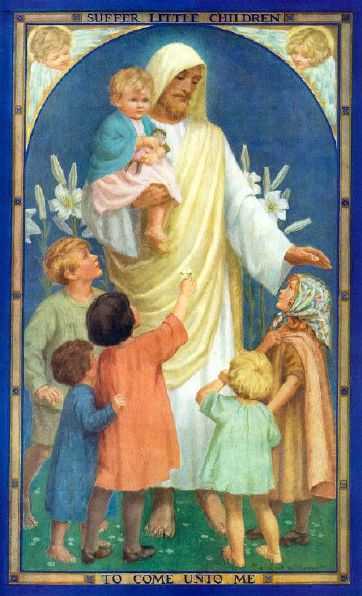
Maybe one has encountered a baptismal font with the phrase “suffer little children to come unto me”. For the modern reader the term “suffer” has an inherent negative meaning, we relate it to the concept of affliction. The translators of the King James Bible used the term “suffer” much more benignly, it simply means “allow” and can even have positive connotations, as we encounter in this case where Jesus is seeking little children to surround him against prevailing custom. “Suffer” here is meant to denote a full inclusion and acceptance, not a space of perdition that must be endured. The term “suffer” once pointed to a neutral or even positive reality while now the term refers to negative realities. The word and that to which it points has changed.


So if we are to take “the name of the only Son of God” seriously as a statement it is not as simple believing in the name “Jesus”, or “logos/word”, or ‘bread of God/life”, or “king of Israel”, or “good shepherd” to state the other names that John uses to name that which is "Jesus". We also need to be ensuring that the name continues to point towards that which is “Jesus”, and not to some lesser idol of our own creation. What we are asked to question is if when we say “I believe in the name of Jesus” are our beliefs pointing us towards that which is “Jesus”? It could even be asked can a person believe all this is inherent to that which is “Jesus”, as much as any one can, but not associate such with the name “Jesus”? The reality being that what many associate with the name “Jesus” might fall very short indeed to the reality that believers profess while those who do not use the name "Jesus" might indeed be using other words that point directly to "Jesus" in many ways.

This is why it is important to search deeper than simply a name, and ask ourselves what does that name actually point towards. This takes us beyond nominal face values and forces us to regard the truths to which we are trying to point, and to find when and where individuals are seeking to point towards those truths. It is my thought that our goal should always be to find those places where people are oriented towards the truth of Jesus Christ, and let the names by which those truths are known become manifest, incarnate even, as they will.

In order to suffer all coming to "Jesus" it means that we must suffer being sure that we fully know the names that point to "Jesus" to fully address if our use of the term points us to the reality.