reflections of a barely millennial episcopal chaplain...

Sunday, January 24, 2016

God in the Tesseract: Remembering the Ordination of Florence Li Tim-Oi

"God does not change, He is the same today as He was yesterday and will be tomorrow."
                                                              -conservative railing against change...


a model tesseract created in two dimensions by a sequence of
three dimensional diagrams displayed in the right linear order
Like mosts points of heresy the statement above takes a truth, the wholeness and perfection of God beyond change, and then places it in an inappropriate context, the changing and tumultuous existence of created beings within time and space.

The reality is that God does not exist. Existence is dependent upon time and space. Existence is what flows from God, in creation, it is something which God can experience and within which be experienced as fully as existence allows, but it is not something upon which God depends.

To say that God is the same today, as yesterday, and tomorrow is to place God in a box... a box we do not even recognize we are placing God within because it is the Box of Linear Time within which we confine the vast majority of our perspectives. To that end, while still ultimately faulty, we must take God out of the Box and strive to put God in the Tesseract.

We all know how to draw a square on a piece of paper, a two dimensional object, and we handle various types of cubes, three dimensional box shaped things, everyday. A tesseract is this type of object in four dimensions. We can only experience it as a cube, because we move through time in a linear way, but the tesseract itself consistently has characteristics of which we are not aware but might become aware as we shift forward in time. In more familiar terms the Holy Spirit will continue to teach us new things.

Now this is still a broken metaphor, the tesseract is nothing but a more advanced box that limits the nature of God... but it is a less broken metaphor than one that speculates God as a held constant within the confines of time, which is what we so often are trapped into doing by our limited perspective.

Now let us ground ourselves on a specific point in time... January 25th, 1944. Japan was invading China and all foreigners were required to leave and this exodus included all of the Anglican clergy in the country. The one exception was a deacon, Florence Li Tim-Oi. Bishop Ronald Hall made a decision to ordain Florence Li Tim-Oi, who showed all charisms of a call to priestly ministry, to the priesthood and thus provided the Anglicans in China a servant to aide them in going about sacramental ministry... a need so pressing that the reality of Florence Li Tim-Oi being the first woman allowed to enter such a role was suddenly no longer of consequence.

There are two options about what occurred at this moment. The first is that there is a simple box about who God is and that we have to stay in that box whose lines are known. If this is the case then the Rev'ds Hall and Tim-Oi broke a wall in this simple box and walked outside of God's purview. I continue to find this a rather sad and simplistic construction of God more like unto an idol than anything requiring an actual depth of faith. The other option is that an ontological reality always possible but simply not manifested within our linear context fully manifested itself.1 To put this more simply, something that always could have been happened. Or, to go back to our initial model, a shift occurred in the tesseract which shifted the nature of the cube we can reference within our spacial and temporal reality and thus revealed a deeper truth than the one previously known.

The second possibility, the one I hold to, is a bit scary. It requires faith in a God whose nature is not only at points unknown but who is in reality unknowable. It requires a constant humility in the face of the erosion of understanding and the potential shifts of the box of who God is and what is of God. It holds up faith in a process of discernment and understanding, but is doubtful and suspicious of the static set of known facts considered immovable and set. It does not deny the unchanging nature of God but does recognize the problematic viewpoint by which we have to grasp said nature... more than anything it is prepared to encounter points of intense revolution where pastoral necessity upends historic boundaries of what is pastorally appropriate or theologically sound. It recognizes the Rev'd Florence Li Tim-Oi not only for the pragmatic reality of her blessed life and service with us but the fulfillment of ontological realities brought into our keen by that blessed life and service.


1 It is important to note that in all probability this was not the first manifestation of this ontological reality within our perception of linear time. Earlier manifestations from the first centuries of Christianity were simply ignored, repressed, and forgotten by later centuries.

Sunday, January 17, 2016

Of Communions and Consequences...

The hope of this post is to give an understanding of the systems of thought at play in the midst of the Anglican Communion and the Consequences placed upon TEC/DFMS in light of our advocacy and inclusion for LGBTQ+ individuals and their Proclamation of Christ Crucified. It is geared toward members of TEC/DFMS in hopes that they can gain insight into systems other than our own and how that might inform and condition viewpoints. It is not meant to advocate or excuse any actions or sides (for the authors personal opinions on the subject of LGBTQ+ issues please see his other works).

Firstly we must ask: What is the point of courts, laws, arbitration, and justice? (individual vs communal)

In America we generally approach questions around issues of law and justice from the point of personal vindication and the individual having their rights acknowledged and due compensation given. This is what we have inherited from Western European civilization.

Some other societies, including those with Anglican churches, approach questions around issues of law and justice from the point of view of a community's need for peace, reconciliation, and continued functionality. In the midst of this personal vindication and individual rights can be placed aside if such ensures overall harmony and well being within the community.

Both concepts have strength and weaknesses. Both at their best strive to recognize the basic rights of every individual and also maintain community harmony. The problem arises when the system is forced to decide in one way or another... our system will advocate for the needs of the one over the needs of the many while the alternative system will advocate for the needs of the many over the one.

It is important to recognize that both concepts of law and justice are expressed within systems and cultures that are not egalitarian and struggle with issues of racism, sexism, heterosexism, and cisism. Blaming the concept for the system and culture that it inhabits and the manifestations of kyriarchy therein is not useful.

When forced we will choose to take the needs of LGBTQ+ individuals over the maintenance of the Anglican Communion while they will choose to take the maintenance of the Anglican Communion over the needs of LGBTQ+ individuals. All sides would desire that both the needs of LGBTQ+ individuals and the maintenance of the Anglican Communion could occur but when forced to choose one over the other in the midst of a disagreement about what those needs are, our concepts of the purpose of law and justice bring us to different ends.  

Secondly we need to recognize that alternative views on LGBTQ+ issues are not simply American views on LGBTQ+ issues from the 1950s.

The various movements for liberation of oppressed and minority groups in America, and Western Culture in general, builds upon preexisting concepts of individualism and liberalism that are not inherent to human society. We simply assume that everyone basically agrees with John Locke and his concept of each individual's right to life, liberty, and property. We do this to such an extent that many of us do not even know that the philosophy of John Locke is a key cornerstone of our society.

What is important to realize, as Christians, is that John Locke's Christology was Socinian. It rejects the eternal transcendent nature of Jesus Christ, Jesus as Logos, and thus is not within what is generally considered orthodoxy. In the end his overall philosophy requires the acceptance of certain concepts that are simply not reconcilable with orthodox doctrine. Which is not to say that the human rights advocacy made with such arguments are not reconcilable with the Gospel, but the mechanisms and rhetoric by which they have been brought about at points very much are.

Now this might seem very confusing. We generally do not engage our day to day thinking in this way. America is somewhat unique in how pervasive one particular philosophy permeates the majority of our culture to such a great extent. There was an expectation of conformity after WWII, through McCarthyism and other methods, that perpetuate a unique reality in our culture to this day and underpins our conversation and thinking across our society's spectrum of conservative and progressive. This pervasiveness exists, to a lesser extent, in the rest of western european civilizations but can become completely absent once outside of it.

Our arguments for the inclusion of LGBTQ+ individuals take for granted this shared acceptance of John Locke's thought. That means they actually make little or no sense outside of that philosophical frame work. The problem is that since we take this philosophical frame work for granted we do not recognize we are using it and we do not know how to clearly articulate its importance and value. Further because at many points our arguments actually require taking the gospel of John Locke over the Gospel of Jesus Christ from an outside Christian perspective they look not just worldly but heretical.

This is not to say that the full inclusion of the LGBTQ+ community and the recognition of their Proclamation of Christ Crucified is not inherently orthodox and part of the Gospel truth... but that we are yet to clearly articulate it in such a way that is understandable in a context other than our own. We presume the same context as our own well outside of its boundary and then, not realizing the breakdown of communication that is happening, respond to outside inquiry and detraction as if it is occurring within our context. The issue is not simply a disagreement within an overall philosophical worldview, what we generally experience in our conversations within the United States, but exceptionally different philosophical world views.

To put this in perspective consider various levels of math. Two American Episcopalians have a conversation and we can take a level of common knowledge and worldview for granted such that we are dealing with basic addition and subtraction in the midst of disagreement. Have that same conversation with an American who is a Southern Baptist and the lack of common ground has heightened the conversation to a complexity equal to Algebra. By the time we are seeking to have this conversation across the Anglican Communion we are talking about a level of systems of thought at play to bring us into the realm of Calculus if not Differential Equations.

If we do not take this heightened complexity into account, and learn to recognize it, make our arguments within it and yes allow our own thinking to be transformed by it... then we simply will not make any progress for LGBTQ+ Anglicans/Episcopalians.

Third, and finally, we have to recognize a complex interwoven cycle of violence within the Anglican Communion.

Each of us, and each of our communities, is made up of a complex set of traits and characteristics intersecting to create who and what we are. Some of these traits give us strengths, such as societal privilege, while others give us weaknesses, such as societal oppression. As a rule if we are hurt upon a line of weakness, a point of oppression, we have a tendency to retaliate along a line of strength, out of our privilege in society. For instance if we are hurt because of our stance on LGBTQ+ issues we could respond in retaliation with how we use, or do not use, our material wealth. This is pushing and pulling along the linked lines of privilege and oppression in our relationships. When we do this we are contributing to the complex and interwoven cycles of violence that permeate the Anglican Communion and we contribute to the perpetuation of violence.

We want to construe the recent events in a linear way outside of their context and history. We want to assume that in the context of the Anglican Communion every Primate comes to the table as inherently equal. Both of these presumptions are flawed and not based on a realistic appreciation of what is at play.

TEC/DFMS maintains an exceptionally powerful position within the Anglican Communion. This is in part because we are principally based in America and America's position in world politics. This is in part because of our material wealth and our capacity to fund, or not fund, ministries and human relief efforts across the Anglican Communion. This is in part because of the historical use of both of these realities to foster churches across the globe.

The reality is that our history is resplendent with not only the racism, sexism, heterosexism, and cisism we struggle to overcome within ourselves but also with problematic concepts of Manifest Destiny, which we officially held until our renunciation of said theology at our General Convention in 2009. The violence we have perpetuated, and continue to perpetuate, on account of American Exceptionalism and the manifold issues systematic oppression concurrent with that, cannot simply be ignored in the midst of this conversation. The conversation has to be made across all of these intersections of privilege and oppression. To do otherwise simply contributes to these cycles of violence and does a disservice to all.

The conclusion is that Christian Community is not easy and often chaotic.

We want to presume that Christians can live in community as explained in Acts chapter 2:

All who believed were together and had all things in common; they would sell their possessions and goods and distribute the proceeds to all, as any had need. Day by day, as they spent much time together in the temple, they broke bread at home and ate their food with glad and generous hearts, praising God and having the goodwill of all the people. And day by day the Lord added to their number those who were being saved.

In context, however, we must recognize that this is a picture of the nascent community of Christians made entirely from Jewish converts... the next story is of gentile converts being promoted to deacons because the needs of widows and orphans, specifically gentile orphans and widows, was not being addressed in the midst of the above community. Shortly thereafter the chaos of arguments and broken community between the party promoting circumcision and the party allowing for the uncircumcised rends the church in twain for a generation.

Christian Community that is actively engaging the Proclamation of Christ Crucified from outside of itself will face chaos and brokenness. It will have to die to certain understandings of itself and be born again. There is not some point of stabilization until the coming of Christ again and the fulfillment of all things in the creation of a new heaven and new earth. For now our place is exactly where we are, in the chaos and brokenness of Christian community within this age. We must enter into this Spirit filled transformational space and not avoid it for our own camp, regardless of what camp that might be.  


More than a Miracle Making Magician...

It was a really bad musical called Miracle Maker. The type of musical just good enough for a small community theatre to buy the rights for so that their youth have something to present and not look absolutely ridiculous. I was one of those youth. The premise is that during a field-trip to a science lab the most fetching male of the class, not my role, gets in an accident and gains the power to perform miracles... quickly he is caught up in his new powers becomes a televangelist, healing people and turning water into wine. Then fame gets too much of him and in the chaos all he wants is for the world to stop... and so it does and everyone but him dies instantly. It is at this point that he performs his last miracle, going back in time to undo the accident that gave him the power in the first place.

The musical itself was rather trash, but it does make a crucial point about the nature of miracles and the horrible potential the capacity to make them can bring about. At the end of the day we are talking about much more than turning water into wine, a carrot into a rabbit, or sawing an associate in half and putting them back together for the applause of the crowd. We are talking about more than the ability to cure the ailments of those who seek wholeness.

At this rate, the walls between dimensions will break down.
We are talking about the capacity to unhinge the very fabric of the universe but not do so.  

We are talking about having this capacity and consistently using it to make the world whole.

We are talking about going about making the world whole and staying centered and grounded amidst the human response to these moments of miracles.

The deal with Jesus is not that he could do spiffy stuff... but that the spiffy stuff he did consistently brought world into a more robust harmony with God.

The deal with Jesus is not that he could do spiffy stuff... but that he could do spiffy stuff and never loose his grounding, center, and purpose in the midst of it.

The deal is that we believe a person walked around the earth with the technical capacity to unhinge the very fabric of the universe at any moment... and that never happened... that in fact the very opposite occurred and the very fabric of the universe was brought toward wholeness.

Mary came and requested a small unhinging of the universe... that wine would come about where no wine was... and Jesus, reluctantly, let his time come. The time when he would start to unhinge the universe bit by bit... the struggle to unhinge it in a way that would not cause further pain and suffering but bring about wholeness... the struggle to unhinge the universe in little ways and not get caught up in the act of unhinging it... the struggle that once taken up could only end with one eventuality... the confrontation of the world as it stood and the world as it should be with his very self, his very flesh, as the focal point for the transformation.

And so it began, with no one but the servants knowing what was going on, and for no greater reason than two families needed a bit more time to celebrate and be joyous with each other. This simplistic silly reason was enough for Jesus to take the plunge into the potential unhinging, but in  the end the the eventual rehinging of the universe and all the responsibilities and eventualities such entailed. So did Mary request the healing of the world, so did Mary request her son begin his path to the cross.


Sunday, December 6, 2015

The Church Shorn (Penitential Advent 2 of 2)

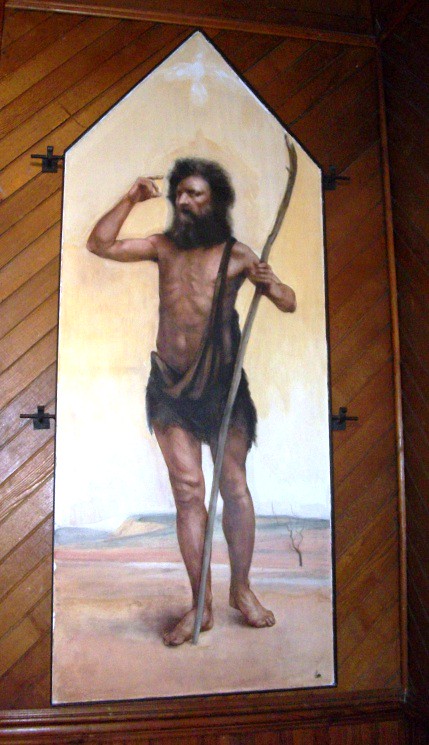
John the Baptist
St. Mary's Episcopal Ashe County

The Episcopal Church is not John the Baptist. The Episcopal Church is the sheep, or in this case maybe the camel, that needs to be shorn to provide clothing to the prophets in our midst. The stark reality being that if we look at the balance of the Episcopal Church in our history and our current culture we do not live in the valley that must be filled... we live in the mountain and hill that must be made low. We exist in the space that must be shorn.

The issue is that too often we want to focus on the context of the individuals in our pews. Without any doubt in each of us, no matter how privileged we are in the system we inhabit, there are distinct valleys that must be lifted up. Places that the cycle of systematic violence we all inhabit have worn raw. These places need to be filled and must have a time of fulfillment. Part of Advent's call is to provide a space for that.

This cannot happen, however, in an individual context unless it happens on a systematic context. If a machine is consistently wrenching a set of cogs too hard, forcing them to wear down to nubs much faster than expected, to replace the cogs will not solve the problem... the entire machine needs to be recalibrated if it is to be sustainable and safe. This is why in Advent we have to ask ourselves how are we, as individuals and a church corporate, needing to recalibrate our own places in the machine in order to prevent the wearing down of others. What mountains and hills create our foundations that are denying foundation to others?

This is a question of how do we need to be shorn, how do we need to be worn down, how does part of us need to be taken away... so that others might be clothed, so that others might be brought up, so that others may have vital realities added. This is the question of how do we confront and dismantle the privilege so often inherent to the Episcopal Church, and many Episcopalians, and bring an end to the oppression that such maintains. This is the Penitence of Advent.

Sunday, November 29, 2015

The Church Pregnant (Penitential Advent 1 of 2)

Mary Great with Child
St. Mary's, W Jefferson, NC
To the woman he said, many are the pangs, many are the throes I will give thee to endure; with pangs thou shalt give birth to children.
                                                                                    -Genesis 3:16b

We speak of Advent as a time of hope, and that is a true statement... but we must also speak of Advent as a time of pangs and throes that we must endure. When we seek to strip the penitential nature out of advent what we are in fact doing is abandoning the pregnant Mary to the desert. We want to gain the hope her trials have bought us but not share the cost of the act that brought that hope.

As a church we are the bearers of Christ in the world. We are the church pregnant with the expectation of Christ's coming again. That means to be church we should be in the midst of pangs and throes that we must endure. That means as individual christians we should be in the midst of enduring pangs and throes as we live lives in proclamation of Christ Crucified. These pangs and throes are at many points indeed our own, but we are equally called to enter into the pangs and throes of others. To be Christian is to be both the pregnant and also the supportive spouse to those around us. We are each others midwives.

For too many decades we have sought to shunt the pangs and throes out of church, this has been especially true in the transitions we have made around Advent, when the realities of such should be most pressing. We have erred toward making the church a place where we can bring and recognize our hope only but not our tribulations. We have erred in making the church a place where the tribulations of the world are given a momentary relief but not borne and brought to fulfillment in Christ. In our hopes to create a space of comfort for all we have failed to create a place that requires the comfortable to enter into the discomfort of others.

We have become, to readily the spouse that does not endure the pangs and throes of childbearing and childbirth. We too often refuse to be midwives for the pangs and throes of those around us... to aid in the bearing of them so that we may truly enter into the Hope of Christ. It is only by entering into these realities, by making them our own, that we can become the Church Pregnant and truly bear the Hope to the world. This is why we must live into the penitence of Advent because pangs and throes are being endured in our midst and in our lives and only by bearing them with each other can we truly find the Hope inherent to the season.

Friday, November 20, 2015

Refugee Christians of The Refugee King

"But as it is, my kingdom is not from here."

The incarnational state is a refugee state. To overcome the war torn reality of the dynamic between heaven and hell the King of Heaven became a refugee on earth. An act of God fleeing the discord of the cosmic reality to be in our midst as one of us... by such affecting transformation to the very core realities of physics and metaphysics back towards mutual harmony.

This refugee status, this status of fleeing from alleged home to alleged home, plagued Jesus from before he was born. First the government forced Mary and Joseph to leave their home and travel eighty miles to Joseph's town of origin for processing. Then, forewarned by the government's plan to orchestrate a mass murder, they flee to Egypt. Only, eventually after years away, able to return to Nazareth and strive to restart a life put so long on hold.

Throughout his ministry he wandered. Rejected from his home town, hounded by crowds that wanted his presence... but in almost every town met by authorities who sought to trouble him, undermine him, and create a space of unwelcome for him. Even in Capernaum, the closest thing he had to a safe haven during his ministry, was a place where his housing security depended on the kindness of his friend Peter's family.

And then we have today's reading from the last day of Jesus' life. Where he names himself of a kingdom not of here... where he names himself a refugee in his very nature. That all of what his incarnated life has been that of a refugee. The ultimate goal of Christians is to live as refugees in this world, we are individuals required to live here while our kingdom is not from here. Just as christ incarnation here held the purpose of affecting transformation of the very core reality of physics and metaphysics towards mutual harmony, so are our lives in this foreign land meant to be the same.

Mary and Joseph took the risks of taking in this refugee and the complications that involved. The homelessness, the lack of personal safety, the public ridicule during Christ's ministry, and eventually Mary watched as her son was killed by the governor that would not accept a refugee to live for the risk his life posed to a stable social order.

There is risk taking in refugees. When one harbors an individual others wish to see dead one risks sharing that fate... one risks becoming a victim with the rest. To reject a refugee from another kingdom, to ensure a bit more safety by such rejection, by allowing the refugee to suffer and to die... we might indeed be able to maintain our status quo and not have the worries and needs of others impressed upon us. This plan to reject a refugee worked for a governor long ago to reach the goal of maintaining the status quo and at least for a little while a concept of public safety remained... this cannot be the plan of the follower of Christ.

As Christians we are refugees in this world and are called, consistently, to take up risks to our lives and status quo for the sake of those fleeing the machinations of hell, war, persecution, suffering, and death. Our duty is to shelter the refugees of this world in order to know fully our own status as cosmic refugees with Christ our King. Without this solidarity, without taking up this mutual risk, we fail fully in our test for citizenship in Christ's Kingdom. The only way to know ourselves as Christians is to know ourselves as refugees and the only way to know of Christ Kingdom is to know that Christ is the Refugee King.