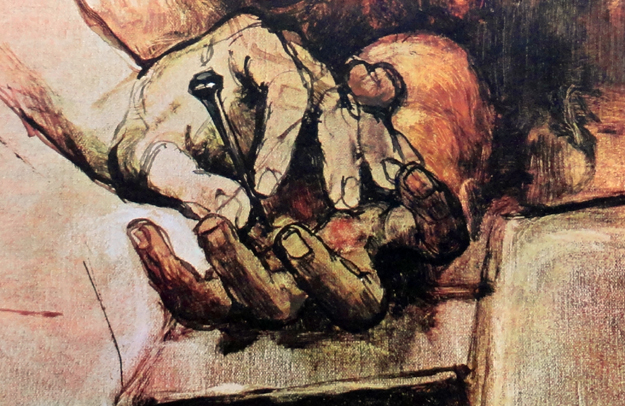
There is a core reality of the cross... that the life of the shepherd has been taken for the sake of the sheep. That act is done, and has been done in a way that transcends time and space. That means to this day when we take up persecution, when we enable oppression, we bring down the hammer onto the wrist of christ. That means to this day when we are the victims of persecution, when we are beaten and broken by our neighbors and the system they enfranchise, that wounds upon our bodies are wounds upon Christ's body. Maybe we are not the person holding the hammer, often we are the one enabling that hammer, too often we are not the one stopping it.
At any point in time we have to ask our selves: how are we crucifying Jesus in our day and age? How is the society we allow to exist around us ringing with the strikes of the hammer against the nail? For the event whose resonance redeems all time and space as surely enters into the pain we inflict upon each other through all time and space. Where is the nail biting against the Body of Christ?
At any point in time we have to ask our selves: how are we crucifying Jesus in our day and age? How is the society we allow to exist around us ringing with the strikes of the hammer against the nail? For the event whose resonance redeems all time and space as surely enters into the pain we inflict upon each other through all time and space. Where is the nail biting against the Body of Christ?
On November 20th what the world is called to do is recognize the nail it is plunging into the Body of Christ, specifically into the Transgender Body of Christ. The hammer is lifted by many, and while white cisgender christian men play a major role they are enabled by a diversity of others. Feminist authors who continue to refuse to acknowledge transgender women as women and transgender men as men. Gay Men and Lesbians who wish to "drop the T" in order to more quickly gain legal protections for themselves. The countless number of us who do not know what the term cisgender means, much less take the time to process it as aspect of our identities.
This wound plays out in many ways. A severe lack of housing and employment security within the transgender population. Problems accessing basic public accommodations, from buses and streetcars to restrooms. Rejection from families, faith communities, and basic social service providers. An inability to find affordable and appropriate health care. All of these caustic realities create a society that continually denies the inherent dignity of transgender individuals. Living without basic levels of respect from the society in which one inhabits is dynamically caustic and escalates the possibility of depression, substance abuse, and suicide.
It also creates a society whose environment enables physical violence. The base reality is that per capita transgender women, especially transgender women of color, are the most likely to be the victims of a deadly hate crime. Over the past decade the number of recorded murders of transgender women has gone up. As of now in 2015 there have been twenty four such murders, one every other week. Their deaths are often ignored, their killers never found, and if tried rarely are charged to the full extent of the law.
There are many places where our society is ripping a nail edge across the tendon's of Christ, a pressing and cutting edge, an edge that cannot be ignored, is the edge of persecution against the transgender community. If we cannot begin to bring a halt to the ringing of that hammer then we cannot truly begin to be fully transformed by the redemption offered by Christ. If we cannot begin to acknowledge and name our sins, known and unknown, against the transgender community then we cannot enter into the depth of God's forgiveness in our day to day lives in their midst.

A first small step is to know the names of this years victims of fatal hate crimes, from thence to learn their stories, and from there to bring about a society where this is not an event we face every fortnight. This week may these names be prayers on your lips. They are sheep of God's fold, children of the family of which we are all members, washed in the blood of the lamb as we placed them on the cross as part of Christ's body.
Papi Edwards, Lamia Beard, Ty Underwood, Yazmin Vash Payne,
Taja DeJesus, Penny Proud, Bri Golec, Kristina Gomes Reinwald, Keyshia Bilge,
Vanessa Santillan, Mya Hall, London Chanel, Mercedes Williamson, Jasmine
Collins, Ashton O’Hara, India Clarke, K.C Haggard, Shade Schuler, Amber Monroe,
Kandis Capri, Elisha Walker, Tamar Dominguez, Kiesha Jenkins, Zella Ziona... You are remembered. Amen.


