reflections of a barely millennial episcopal chaplain...
Showing posts with label transgender. Show all posts

Saturday, November 14, 2015

The Continued Crucifiction of the Transgender Christ...

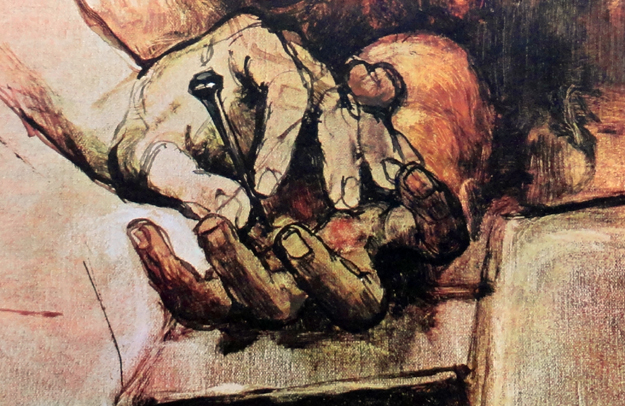
There is a core reality of the cross... that the life of the shepherd has been taken for the sake of the sheep. That act is done, and has been done in a way that transcends time and space. That means to this day when we take up persecution, when we enable oppression, we bring down the hammer onto the wrist of christ. That means to this day when we are the victims of persecution, when we are beaten and broken by our neighbors and the system they enfranchise, that wounds upon our bodies are wounds upon Christ's body. Maybe we are not the person holding the hammer, often we are the one enabling that hammer, too often we are not the one stopping it.

At any point in time we have to ask our selves: how are we crucifying Jesus in our day and age? How is the society we allow to exist around us ringing with the strikes of the hammer against the nail? For the event whose resonance redeems all time and space as surely enters into the pain we inflict upon each other through all time and space. Where is the nail biting against the Body of Christ?

On November 20th what the world is called to do is recognize the nail it is plunging into the Body of Christ, specifically into the Transgender Body of Christ. The hammer is lifted by many, and while white cisgender christian men play a major role they are enabled by a diversity of others. Feminist authors who continue to refuse to acknowledge transgender women as women and transgender men as men. Gay Men and Lesbians who wish to "drop the T" in order to more quickly gain legal protections for themselves. The countless number of us who do not know what the term cisgender means, much less take the time to process it as aspect of our identities.   

This wound plays out in many ways. A severe lack of housing and employment security within the transgender population. Problems accessing basic public accommodations, from buses and streetcars to restrooms. Rejection from families, faith communities, and basic social service providers. An inability to find affordable and appropriate health care. All of these caustic realities create a society that continually denies the inherent dignity of transgender individuals. Living without basic levels of respect from the society in which one inhabits is dynamically caustic and escalates the possibility of depression, substance abuse, and suicide.

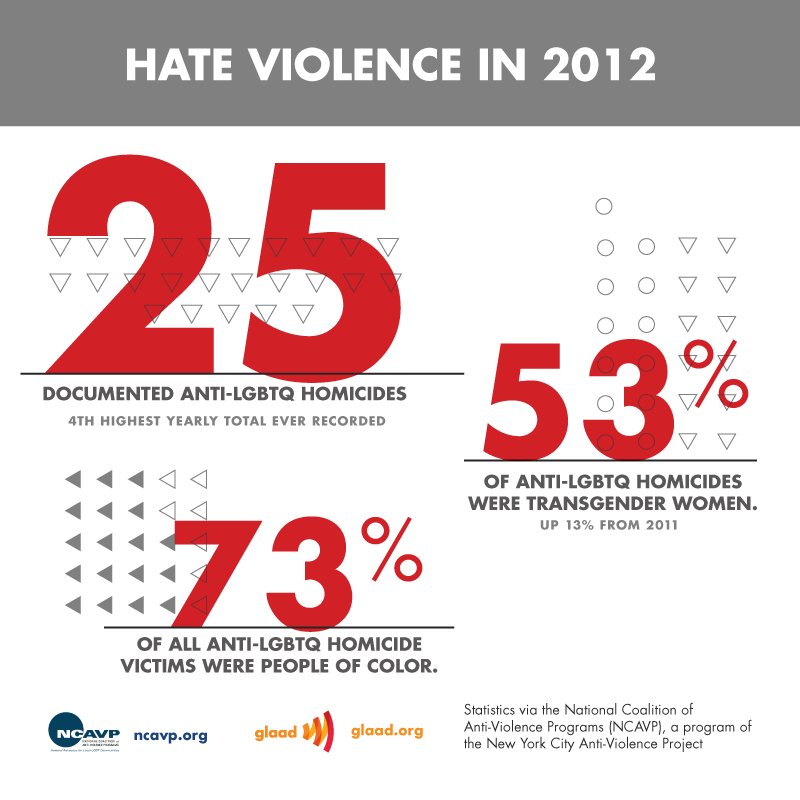
It also creates a society whose environment enables physical violence. The base reality is that per capita transgender women, especially transgender women of color, are the most likely to be the victims of a deadly hate crime. Over the past decade the number of recorded murders of transgender women has gone up. As of now in 2015 there have been twenty four such murders, one every other week. Their deaths are often ignored, their killers never found, and if tried rarely are charged to the full extent of the law. 

There are many places where our society is ripping a nail edge across the tendon's of Christ, a pressing and cutting edge, an edge that cannot be ignored, is the edge of persecution against the transgender community. If we cannot begin to bring a halt to the ringing of that hammer then we cannot truly begin to be fully transformed by the redemption offered by Christ. If we cannot begin to acknowledge and name our sins, known and unknown, against the transgender community then we cannot enter into the depth of God's forgiveness in our day to day lives in their midst.

A first small step is to know the names of this years victims of fatal hate crimes, from thence to learn their stories, and from there to bring about a society where this is not an event we face every fortnight. This week may these names be prayers on your lips. They are sheep of God's fold, children of the family of which we are all members, washed in the blood of the lamb as we placed them on the cross as part of Christ's body.

Papi Edwards, Lamia Beard, Ty Underwood, Yazmin Vash Payne, Taja DeJesus, Penny Proud, Bri Golec, Kristina Gomes Reinwald, Keyshia Bilge, Vanessa Santillan, Mya Hall, London Chanel, Mercedes Williamson, Jasmine Collins, Ashton O’Hara, India Clarke, K.C Haggard, Shade Schuler, Amber Monroe, Kandis Capri, Elisha Walker, Tamar Dominguez, Kiesha Jenkins, Zella Ziona...    You are remembered. Amen.

Sunday, July 19, 2015

A new strategy: where the Episcopal Church fears to go in LGBTQ+ inclusion.

I was a closeted gay teen in the nineties and initially I was presented two possibilities about what would happen if I came out as a gay man. My Anglo-Catholic mentors, with whom I was out inside the confessional booth, opened up the possibility of monastic celibacy and discernment towards the priesthood. The broad and low church clergy and leaders with whom I had contact spoke of reparation therapy. Eventually I discovered Integrity. They offered me a third option. I could be an out gay man, I could have a partner, I could be a priest… as long as everything about my life mirrored that of the heterosexual norms of the church.   

Where does our welcome end?
If these three modes were characters on a improve stage, the comedy would be flat. Decades before I was born they stopped being able to be receptive to one another. Where once there might have been space for dialogue, growth, and understanding there is now only space for stimuli-response. Every group exists with its own cultured positivism, the surety that they have the authority on the subject at hand and the right actions to perform. They have created immutable concepts of orthodoxy and orthopraxy from which they shan’t be moved. It a stalwart example of the decadent heresy of partisanship in which the church so regularly bathes.

Now, to be clear, I realize that I am painting with a broad brush and at points doing a disservice to members and subsets of the various groups. This account is based on my personal experience with groups over decades, striving to process these experiences with peers, and quite often finding my experiences echoed back to me. It comes out of a continued longing for a safe place in the church for myself and also those around me, queer or otherwise, and the frustration I feel about not finding such a space.  The consistent reality that I have had to face is a need to choose a side and know that alignment with one means ostracization, if not worse, from the other.


I want to start then by going back to before these three groups had devolved to less than improv characters on a stage.  I want to, in fact, go back to 1963, a decade before homosexuality would stop being treated as a mental disorder by the American Psychiatric Association. A time when we were legitimately still asking whether homosexuality was as natural as heterosexuality or if it was a problematic acquisition from the natural heterosexual state. It was at this point which a rather wonderful dense text was published by Martin Thornton: English Spirituality.

Now this text is, at its heart, an attempt to create an Anglo-Catholic reading of English History. It is not a text attempting to engage pressing social issues of its era. There comes a point, however, where Thornton is attempting to clarify the theological methods of Tomas Aquinas and chooses to bring up a question of his time. He chose to address the issue of homosexuality, and wrote:

“It is difficult to distinguish between innate characteristics, or “nature”, and acquired habits formed by circumstances. This difficulty must be accepted and its subtlety recognized, but the doctrine remains. Homosexuality is an example, for this can be almost subconsciously acquired, as a developing tendency, or it can be an innate characteristic. In the former case, the tendency should be fought, for it is but an excrescence upon nature; in the latter case it is part of nature, which can be accepted and ultimately sanctified. What must be avoided is the abominable heresy that the “Christian Character” implies a rigid uniformity; that rather than sanctifying our own God-made selves we should ape some other real or imaginary character”
(English Spirituality, Wipf and Stock, 1963, page 133.)

Finding this paragraph in my late teens was a God send for me. It provided me an approach to theological and spiritual dissonance around my faith and sexuality that gave me a balm of peace I had not known in my entire life. Unfortunately my finding of it was not well received by any of the three groups. The Anglo-Catholics, who had introduced me to Martin Thornton, did not want to engage the possibility his approach would allow for a change in their approach towards homosexual individuals. The broad and low churchmen were not exceptionally interested in any argument based in Thomism. Those in and about Integrity were strongly advocating I stop caring about Thornton, Aquinas, or any of the tradition that challenged the concept of including conforming members of the LGBTQ+ community.   

The resistance is understandable as what Thornton puts forward strongly critiques all three. Its first critique is towards those who consider homosexuality to be an acquired deviation. Thornton was still using a theory of Freud that some individuals took up homosexuality as an acquired trait. Even though Freud himself noted it was inherently impossible to “cure” homosexuality many have attempted this impossibility. As our scientific understanding of sexuality has grown since 1963 it is now recognized that sexuality and sex are naturally formed by a complex series of factors we do not fully understand and are not acquired traits. At this point what science has revealed to us is that individual’s who acquire LGBTQ+ identities as a developed trait, if they exist at all, are an exceptionally small minority subset of the LGBTQ+ community. That across the board individuals who identify in the midst of the LGBTQ+ community are expressing their natural characteristics.

To state this in another way, for a long time we considered members of the LGBTQ+ community to be guilty of acquiring their LGBTQ+ identity unless proven otherwise. At this point medical science has shown, repeatedly, that an LGBTQ+ identity can be taken as an inherit naturally occurring characteristic of an individual with the rare exception being a case of acquired psychosis. Our theological and pastoral response to the LGBTQ+ community must be based on the idea that their characteristics are inherently part of their nature.

The next twist we have to deal with is recognizing that the Anglo-Catholic response I encountered and the response from Integrity are, in fact, the same response. Both groups take LGBTQ+ identity to be an inherent trait in need of sanctification. Their difference is simply in the allowable mechanisms for that sanctification. Both expect “that the ’Christian Character’ implies a rigid uniformity” and that conforming to this uniformity will bring about sanctification. The Anglo-Catholic expectation being those not called to biologically procreative sex must conform to a call to monasticism, or at least celibacy. What Integrity has sought is that LGBTQ+ individuals and families be able to conform to the rigid uniformity of individuals and families already existing in the Episcopal Church. Members of the LGBTQ+ community who can readily conform to expected gender expressions, norms, and family systems we already have in our church should be free to do so. What happens if someone does not pass well in their gender expression, of if that expression is not a clear choice of either male or female... what happens if there is a twenty or thirty year age difference between spouses... what happens if someone's black slacks are neoprene not wool... 


Creating a space in which people are allowed to sanctify their own selves and not ape some other real or imaginary character is a difficult process. LGBTQ+ individuals cannot be expected to ape real or imagined characters of the non-LGBTQ+ community. Our theological and pastoral approach to them has to recognize their capacity to sanctify their own selves within our communities. Yes, this means that some LGBTQ+ individuals will be called to celibacy and monastic life. Yes, this means that some LGBTQ+ couples will be called to monogamy and married life. Yes, this means that some LGBTQ+ individuals are naturally going to assimilate into expectations of Episcopal norms. These are real characters of being across the spectrum. The issue is that the Episcopal Church is not called to be a safe space just for those people, LGBTQ+ and elsewise, for whom our norms is the real character of their being… The Episcopal Church is called to create the community that allows individuals to sanctify their God-made selves, to become Christian Characters, not ape our preexisting notions of “Christian character”.


The reality, at least from what I hear from my peers who are the younger leaders of the Episcopal Church, is that we want a church that takes both the historic voices of the church and the current voices of the LGBTQ+ community seriously. That there is a recognition that the “Christian character” espoused by any one group, Thomists, Integrity, or other… is going to have some major problems to it. That the goal of Christian Community is to bring individuals to a point where they can be open to sanctifying their God-made selves and place aside a set of expectations to which we must conform and ape. Until we can move beyond the expectations of positivism, that one group or individual has it right, we will continue to cut individuals off from a space where they can experience sanctification.

Wednesday, May 20, 2015

At the start of the conversation: Where Sacramental Marriage Equality will place the Episcopal church...

The Episcopal Church has gone about the inclusion of the LGBT community in its own curious way. As we are a prayer book people our process of inclusion has been about allowing the inclusion of LGBT individuals into our prayer book rites. While at some point a hurdle has been placed before every rite in the Book of Common Prayer the two major hurdles for the LGBT community have been that of entering into the rite of Ordination and the rite of Marriage. There might have been better paths we could have taken but I am not sure if, given our strengths and weaknesses as a church, we were actually capable of any other. This path does, however, have ramifications that, on account of our perspective, I am not sure we recognize.

What has been asked from the LGBT community is that the Grace manifested in their lives be recognized and named as such by the Church. That the inward invisible grace alive and well in the LGBT community be placed in the context of the Church’s outward and visible signs. The struggle we have been taking up is that of bringing the church to a point where it is capable of discerning, openly and honestly, the fruits of the spirit that manifest themselves when Christ’s Crucifixion is Proclaimed within the LGBT community. This is the basic struggle the church has encountered throughout history as outsider groups have begun to openly make such proclamations and in so doing call into question things taken for granted by the church.

A trap that we have fallen into repeatedly, in these discussions and others, is speaking about access to the sacraments as inalienable rights. This is simply bad theology. When we are dealing with matters of Sacrament we are dealing with matters of Grace and no individual has an inalienable right to Grace. Grace is the fundamental reality of God’s creating, redeeming, and sustaining us from which the natural order flows and it is upon that foundation that arguments of inalienable rights are then built. One simply cannot build a functioning theology of God’s Grace thats foundation is the inalienable rights of individuals.

The problem is that while the grace denoted within Ordination and Marriage might be the ones that we are most prepared to discern and able to facilitate they only engage the tiniest fraction of the fruits of the spirit manifesting themselves in the LGBT community and the greater LGBTQ+ community. The Q+ signifying individuals whose reality simply is not readily contained within the terms Lesbian, Gay, Bisexual, or Transgender but is also contained neither within heteronormative nor cisnormative contexts. Discussions of Ordination and Marriage allow us to engage and work with members of the LGBT community whose lives generally conform to our preexisting concepts of ordained clergy and married couples. Individuals who are as close to white european heterosexuals as one can be and also be LGBT. It also means that we are primarily focused on LGBT adults.

Now these are good conversations to have, we have to start somewhere and on account of our context as a church these were the conversations that we were going to fall into before all others. The problem is that the church, even at points the LGBT individuals in the church, think this is THE conversation with the LGBTQ+ community. That a church with LGBT individuals being ordained and married is a church inculturated and aware of the Grace of God manifesting itself within the LGBTQ+ community. This is simply, and overwhelmingly, not the case.  

This summer we will be continuing the conversation around wether we will recognize the grace manifest in many same gender couples for what it is, Marriage. Some want space to keep the conversation percolating on local levels, some want local levels to be able to name the grace for what they know it to be, some want the time for this conversation to be over and the recognition of this grace to be Marriage throughout the church. There is a chance that, on the national level, the conversation will be closed. Regardless, however, the local conversation will be far from over.

In some places an end to the conversation on a national level will make the conversation easier on a local level and in some cases it will not. That is the case with any of the outcomes above, and I think what will make the final decision at the end of the day is which of the three possibilities before us will best facilitate further honest and open conversations with the LGBTQ+ community that lead, as we have found them to do, towards the inclusion of LGBTQ+ individuals. It is, in my mind, the perpetuation of those conversations that is of utmost importance, far beyond the actual pronouncement around marriage.

What the LGBTQ+ community has within it to transform the Church in regards to its witness about the Grace of marriage is huge. The LGBTQ+ community inherently moves us towards an understanding of Marriage outside of the oppressive gender norms inherent to its use in our history. As the church fumbles towards an understanding of the Grace of Marriage that is not determined by patriarchy it is the queer voice that will be key in the subversion of this gender oppression and the undermining of patriarchy. This is, however, only the smallest of ripples that the LGBTQ+ community has to offer a church willing to be transformed by the grace manifesting itself in our midst as we proclaim Christ Crucified. 

The conversation so far towards the inclusion of the LGBT community in regards to Ordination and Marriage is not THE conversation the church needs to have with the LGBTQ+ community. It is the conversation we needed to have so that we could have in our midst those able to facilitate the actual conversation between the church and the LGBTQ+ community. The LGBTQ+ community is truly diverse, way beyond the spectrum of those individuals whose lives and patterns, like my own, can readily fit into the expected norms of the church. For those of us from the LGBTQ+ community who fit in It is rather easy to forget that the rest of the LGBTQ+ community exists and has overwhelming value for the church. It is easy for those whose only experience of the LGBTQ+ community are the LGBT individuals who readily fit into the church to even know that we are not all that there really is to know. It is easy for us to fall into an echo chamber and think that because we all are hearing the same thing the full conversation is taking place. 

No matter what happens this year at General Convention the conversation will be extraordinarily far from over. The conversation to include the LGBTQ+ community that can readily conform to our general expectations within our norms is the easy one, it is the minor one. The actual conversation is the one ahead of us, the one were we begin to ask not how can the church readily include the LGBTQ+ community in its midst but how can the church be transformed to a deeper and greater understanding of God’s Grace through the unique proclamation of Christ Crucified by Queers. The conversations will be like unto those that tore through the church after the early Jewish followers of the Rabbi Jesus began to be transformed by early Greek followers of the Way of Jesus. It is for those that we must prepare ourselves, more than anything else. 

Tuesday, April 7, 2015

Wedding Cakes Iced in Transgender Oppression

The reality is that right now in the majority of America it is legal to discriminate against the LGBTQ+ community. In most of the country one can readily fire or evict a member of the LGBTQ+ community for no other reason except that characteristic of their being. There are other characteristics, intrinsic ones such as race or sex, and chosen ones, such as religion, that are protected but not sexuality or gender expression. We talk about the issues around the new forms of Religious Freedom Restoration Acts, but what these really do is make the already legal discrimination easier, as the burden of proving that the discrimination should not be allowed is placed on the victim. They also make the fact that such discrimination is legal a known reality, they enfranchise those who otherwise would not realize that they could discriminate.
 
The fight for this has primarily been around providing goods and services to gay weddings, be it cakes, flowers, photography, or in the most recent case of note pizza. The reality is that gay couples are not actually finding it difficult to obtain bakers, florist, photographers, or caterers to provide services for their weddings. They might find set backs and inconveniences, which they should in no way face, and the reality is that any service provider who alleges to provide to the general public should provide to the general public, but the actual fall out from these acts of discrimination are minor. Again, this does not mean they should be ignored or discounted but that they need to be recognized for the small reality, both in scope and numbers, that they are.

The reality, however, is that the focus on bakers not providing cakes for weddings distracts us from a larger reality, both in scope and numbers, that is predominately ignored. The number of cases, at least where the issue has come to court, of wedding vendors denying services to a same gender couple is, as far as I can tell, under twenty five in the last decade. Each one gets a lot of publicity from both sides and is touted as the reason why we must have various protections, be they for religious groups or the LGBTQ+ community. Compare this, however, to the fact that since 2008 over one hundred transgender individuals have been violently murdered in the United States. Seven transgendered women have been violently murdered since the start of 2015, while there have been no cases filed about wedding vendors failing to provide services to same gender couples in that same time.

I honestly do not understand why the focus of these discussions continues to be around wedding vendors. These acts of discrimination are miniscule in relationship to the violent hate crimes committed against the transgender community. The majority of hate crimes that end in murder against the LGBTQ+ community in America are Transgender Women of Color. More transgender women were murdered in 2012 than reported cases of wedding vendors denying same gender couples services up to that point in American history, a total of about eleven by the end of 2013. The core reality is that hate crimes against our community, specifically targeting the most vulnerable of our members, has been occurring for decades but the non-discrimination ordinances and laws that would send a clear message about the status of LGBTQ+ individuals is for the most part breached in regards to wedding vendors providing services to, by and large, the least vulnerable of our community.

We are now facing a reality where we have marriage equality in states where there are no non-discrimination laws. The effect of this is that those members of the LGBTQ+ community who can readily navigate around discrimination have access to the privileges and responsibilities they need to normalize into the predominant norms of our culture, with the small chance of having to find another wedding vendor. In the midst of this the animosity to passing non-discrimination ordinances and legislation, which in the end always crumbles into nasty rants portraying transgender individuals as sexual predators, is greater than ever. This is the price of how we have engaged LGBTQ+ rights in this country, seeking first the more rarified protections allowed to some by marriage, while placing aside the need for basic protections for all of the community. The west coast and the north east have, for the most part, a functioning reality for the entire community, but those of us in the fly over zone are left in the lurch outside of isolated islands of municipal ordinances. 

Nationally, and in the vast majority of states, our laws tell our citizens that it is perfectly acceptable to discriminate against members of the LGBTQ+ community, even if they can legally marry. This adds to a general milieu that enfranchises hate crimes against the most vulnerable in the community. The horror is that we are struggling to bring about non-discrimination legislation in a way that does not confront the very real harm, and murder, of our members. We are allowing the discussion perpetuate itself in the petty realm of wedding cakes and not confronting the true horror of our society and the tide of transgender blood.


It might be argued that the realm of wedding cakes, no matter how petty, is a palatable realm in which we can get said legislation passed. The reality, however, is that the point of struggles for equality before the law is to confront society with the actual horrors they are perpetuating and to make those abuses of individuals society considers palatable no longer palatable. The goal is to lift up those individuals we now leave destitute to a place of basic recognition; to not only change the law but alter the cultural and societal fabric in which our laws are grounded. If we do not consistently require ourselves, our neighbors, and our legislators to fully confront the horrors they are allowing to perpetuate then we are, in fact, aiding in their perpetuation.