reflections of a barely millennial episcopal chaplain...

Wednesday, May 20, 2015

At the start of the conversation: Where Sacramental Marriage Equality will place the Episcopal church...

The Episcopal Church has gone about the inclusion of the LGBT community in its own curious way. As we are a prayer book people our process of inclusion has been about allowing the inclusion of LGBT individuals into our prayer book rites. While at some point a hurdle has been placed before every rite in the Book of Common Prayer the two major hurdles for the LGBT community have been that of entering into the rite of Ordination and the rite of Marriage. There might have been better paths we could have taken but I am not sure if, given our strengths and weaknesses as a church, we were actually capable of any other. This path does, however, have ramifications that, on account of our perspective, I am not sure we recognize.

What has been asked from the LGBT community is that the Grace manifested in their lives be recognized and named as such by the Church. That the inward invisible grace alive and well in the LGBT community be placed in the context of the Church’s outward and visible signs. The struggle we have been taking up is that of bringing the church to a point where it is capable of discerning, openly and honestly, the fruits of the spirit that manifest themselves when Christ’s Crucifixion is Proclaimed within the LGBT community. This is the basic struggle the church has encountered throughout history as outsider groups have begun to openly make such proclamations and in so doing call into question things taken for granted by the church.

A trap that we have fallen into repeatedly, in these discussions and others, is speaking about access to the sacraments as inalienable rights. This is simply bad theology. When we are dealing with matters of Sacrament we are dealing with matters of Grace and no individual has an inalienable right to Grace. Grace is the fundamental reality of God’s creating, redeeming, and sustaining us from which the natural order flows and it is upon that foundation that arguments of inalienable rights are then built. One simply cannot build a functioning theology of God’s Grace thats foundation is the inalienable rights of individuals.

The problem is that while the grace denoted within Ordination and Marriage might be the ones that we are most prepared to discern and able to facilitate they only engage the tiniest fraction of the fruits of the spirit manifesting themselves in the LGBT community and the greater LGBTQ+ community. The Q+ signifying individuals whose reality simply is not readily contained within the terms Lesbian, Gay, Bisexual, or Transgender but is also contained neither within heteronormative nor cisnormative contexts. Discussions of Ordination and Marriage allow us to engage and work with members of the LGBT community whose lives generally conform to our preexisting concepts of ordained clergy and married couples. Individuals who are as close to white european heterosexuals as one can be and also be LGBT. It also means that we are primarily focused on LGBT adults.

Now these are good conversations to have, we have to start somewhere and on account of our context as a church these were the conversations that we were going to fall into before all others. The problem is that the church, even at points the LGBT individuals in the church, think this is THE conversation with the LGBTQ+ community. That a church with LGBT individuals being ordained and married is a church inculturated and aware of the Grace of God manifesting itself within the LGBTQ+ community. This is simply, and overwhelmingly, not the case.  

This summer we will be continuing the conversation around wether we will recognize the grace manifest in many same gender couples for what it is, Marriage. Some want space to keep the conversation percolating on local levels, some want local levels to be able to name the grace for what they know it to be, some want the time for this conversation to be over and the recognition of this grace to be Marriage throughout the church. There is a chance that, on the national level, the conversation will be closed. Regardless, however, the local conversation will be far from over.

In some places an end to the conversation on a national level will make the conversation easier on a local level and in some cases it will not. That is the case with any of the outcomes above, and I think what will make the final decision at the end of the day is which of the three possibilities before us will best facilitate further honest and open conversations with the LGBTQ+ community that lead, as we have found them to do, towards the inclusion of LGBTQ+ individuals. It is, in my mind, the perpetuation of those conversations that is of utmost importance, far beyond the actual pronouncement around marriage.

What the LGBTQ+ community has within it to transform the Church in regards to its witness about the Grace of marriage is huge. The LGBTQ+ community inherently moves us towards an understanding of Marriage outside of the oppressive gender norms inherent to its use in our history. As the church fumbles towards an understanding of the Grace of Marriage that is not determined by patriarchy it is the queer voice that will be key in the subversion of this gender oppression and the undermining of patriarchy. This is, however, only the smallest of ripples that the LGBTQ+ community has to offer a church willing to be transformed by the grace manifesting itself in our midst as we proclaim Christ Crucified. 

The conversation so far towards the inclusion of the LGBT community in regards to Ordination and Marriage is not THE conversation the church needs to have with the LGBTQ+ community. It is the conversation we needed to have so that we could have in our midst those able to facilitate the actual conversation between the church and the LGBTQ+ community. The LGBTQ+ community is truly diverse, way beyond the spectrum of those individuals whose lives and patterns, like my own, can readily fit into the expected norms of the church. For those of us from the LGBTQ+ community who fit in It is rather easy to forget that the rest of the LGBTQ+ community exists and has overwhelming value for the church. It is easy for those whose only experience of the LGBTQ+ community are the LGBT individuals who readily fit into the church to even know that we are not all that there really is to know. It is easy for us to fall into an echo chamber and think that because we all are hearing the same thing the full conversation is taking place. 

No matter what happens this year at General Convention the conversation will be extraordinarily far from over. The conversation to include the LGBTQ+ community that can readily conform to our general expectations within our norms is the easy one, it is the minor one. The actual conversation is the one ahead of us, the one were we begin to ask not how can the church readily include the LGBTQ+ community in its midst but how can the church be transformed to a deeper and greater understanding of God’s Grace through the unique proclamation of Christ Crucified by Queers. The conversations will be like unto those that tore through the church after the early Jewish followers of the Rabbi Jesus began to be transformed by early Greek followers of the Way of Jesus. It is for those that we must prepare ourselves, more than anything else. 

Monday, May 4, 2015

Will the Body of Christ Proclaim the Crucifixion as One Body? LGBTQ+ Sacramental Equality and the hallowing of the Episcopal Church

A perfect sacramental storm has begun to brew in the Episcopal Church. The various fronts are all meandering towards General Convention where we will discuss, and hopefully reach a resolution, on the issue of full sacramental marriage equality in the church. Meanwhile, however, a local storm is brewing off the coat of Florida, where over the past week the leadership at the Cathedral Church of St. Luke in Orlando sought to reschedule an infant’s baptism on account of his two fathers. As some are battening down the hatches and others hoping to surf the waves, I find myself reflecting on how this reveals the heart of sacramental theology.

The issue is that sacramental marriage equality is not the same thing as civil marriage equality. The writing of one’s name into the Book of Life at baptism is not the same thing as getting your name in the county records at birth. In cases of civil marriage and one’s name in the county records one is dealing with a situation where the primary reality is that of individual rights and freedoms. There is a corporate reality to it when it comes to access of services, and any undocumented worker or couple seeking the rights and privileges of marriage can fully explain how necessary that corporate reality is, but the argument and focus is on the rights of the individual in pursuit of life, liberty, and happiness.

The sacraments of marriage and baptism are different creatures. They are corporate affairs of the Body of Christ. Though the arguments towards respecting the dignity of the individuals involved is an inherent one to our baptismal covenant it is, indeed, a secondary one. When approaching why it is that we should recognize the sacramental nature of an individual in baptism or a couple in marriage the onus of the argument is that of the community recognizing God in their midst present in such. To be clear the sacraments in these cases are about the revealing of the already existing Truth within the individuals to the community of believers for the sake of transforming the community. This is hallowing, the transforming process of sanctification.

In Baptism the community is transformed in the revelation that a member that it did not know was keenly missing is found. In Sacramental Marriage the community recognizes the outpouring of Gods grace within a couple so that they are known as an Icon of the greatest commandment, to love your neighbor as yourself. The community is then called upon to be transformed by these revelations and to consistently support the individuals involved such that they remember that which they are known to be.

The issue that arises is what happens when a community cannot handle the revelation of such an Icon in their midst. This is the earliest of Christian controversies. What occurs when a woman, or a slave, or an uncircumcised proclaims Christ Crucified and names themselves, to a group of freed circumcised men to be an equal part of the Body of Christ. The answer is chaos, strife, argumentation, the breaking apart of the accepted societal norms that were maintaining the peaceful running of the community. Our call as Christian community, however, is to enter into this place of contention and work its way out. To break the rules, as the Episcopal Church is want to do, first and figure out how the Holy Spirit makes it work later. The strife of a community grappling to recognize an unknown revelation of Christ’s love is inherently preferred over the strife that occurs when a community refuses to grapple with the proclamation of Christ Crucified from those it deems unworthy so to do. The onus of the other’s cross, the burden of strife, should always be taken up by the Christian community and never placed upon those seeking to bring a new revelation of Christ’s love.

Gamaliel’s wisdom to the Jewish elders about Christianity holds true to this day for the church. When we hear those proclaiming Christ Crucified we must not burden or silence them but allow them to be for “if this plan or this undertaking is of human origin, it will fail; but if it is of God, you will not be able to overthrow them-in that case you may be found fighting against God!”. (Acts 5:38b-39) The reality is that the Episcopal church has spent over half a century observing the proclamation of Christ Crucified by the LGBTQ+ community within and outside its midst. During that time we have had radical moves of welcome, when St. George’s Episcopal, New Orleans, was the only church to open its doors for a memorial service after the UpStairs Lounge Arson in June of 1973, to the more common acts of rejection such as the recent resending of a baptismal date at the Cathedral in Orlando. What we have found, again and again, is that Christ is with us in the midst of being transformed by the proclamation of Christ Crucified by members of the LGBTQ+ community.

As this storm continues to brew and the fronts collide in Salt Lake City in two months time the question before us is not whether same sex couples have the right to sacramental marriage. It is not whether the children of same sex couples have the right to be baptized in the church. The question before us is whether the Episcopal Church is open to being transformed by the Grace of Christ as revealed in the proclamation of Christ Crucified by the LGBTQ+ community. 

The messiness of the situation, the strife, the pain is not going to go away anytime soon... what we will be deciding is wether we as a church are willing to take up that messiness, that strife, that pain together as one Body in Christ or will we enter into full Proclamation of Christ Crucified with our LGBTQ+ members... or will we continue to persecute in oh so many ways those in the LGBTQ+ community who wish to proclaim Christ Crucified in our midst and in so doing place the onus of the mess, the strife, the pain upon them. My continued prayer is that come July we will be one Body in Christ proclaiming Christ Crucified, sharing our mess, our pain, our strife together as one in a great act of hallowing each other into the new heaven and new earth.  

Sunday, May 3, 2015

What is Your Fruitiness Factor? The basis of ethics and morals.

Those who abide in me and I in them bear much fruit, because apart from me you can do nothing. Whoever does not abide in me is thrown away like a branch and withers; such branches are gathered, thrown into the fire, and burned.
                                                John 15:5-6

A recurring theme, for many, in the realm of morals and ethics is a code of actions, some good but many bad, to which we need a disciplinarian. This is a reoccurring theme in many cultures, Christian ones as oft as any other if not more so. Which is odd because Paul specifically marks that Christians are not to be subject to a disciplinarian. (Gal. 3:25) Perchance this is a verse many have chosen to ignore in the text but for me it is always a rather prominent one.

There is a tendency to hold that a lack of a disciplinary rule leads only to the concept of outright hedonism, “do what you will shall be the whole of the law’. It is the absurd idea that the only reason Christians are good is that they have a stern disciplinarian who will burn them eternally if they do not do what is unnatural and inherently problematic, follow the disciplinarians rule book. It is the absurd idea that those who do not have the carrot of eternal paradise would, for some reason, become hedonistic, self-serving, perpetrators of evil if the carrot disappeared. The only reason for “goodness” is a God with a rod.

There might be a worse place to start a foundation for ethics and morals but an entire doctrine based on shame and threats of violence is decidedly not one of them. Shame never teaches any one anything, at best it halts problematic behavior for a short while but it never changes underlying behavioral norms. Violence, or threats of violence, is an equally bad teacher, as it does not prompt any internal change from within but forces complacency for the sake of survival.

Which is why in one of the earliest surviving Christian texts we have Paul clearly repeating a known truth of the Jewish scripture, now made fully known in Christ, that the point of the law is not that of a shaming and violent disciplinarian and that, indeed, in Christ there is no more need for any disciplinarian. Without a disciplinarian, in Christ, we should recognize that “the whole law is summed up in a single commandment, ‘You shall love your neighbor as yourself’”. (Gal 5:14) What we should recognize, as Christians, is that abandonment of disciplinary law is not a call to hedonism of self but a mutual call to fullness of self and other in love. Indeed, disciplinary law must be given up because of how readily it prevents us from entering into this mutual call.

If not upon a disciplinary law with shame and violence than on what should be base our morals and ethics. Does this mutual call motif have any form of litmus test? I believe that intrinsically it does and that the scale by which we gauge it is fruitiness, specifically seeking a high fruitiness factor. John notes that Jesus came so that we might have life, and have it abundantly… and that such life in Christ will bear fruit while life away from Christ will be barren. So the questions of morality and ethics are answered by looking at a situation’s fruitiness factor. 

To be clear, as one must, fruitiness factor is not hedonism. It is not about feeling good, being ephemerally happy, having what one wants, material possessions, etc.. Fruitiness factor, abundant life, is about a life that is centered and grounded, a life that leads a person to be aware of their own dignity and the dignity of others, a life with trials and pain but inherently growth and joy as well. It is a life built on mutuality with each other in the love of Christ. When we find that mutuality of living into the whole of the law we encounter Christ’s fruit in the world. When we do not find it we encounter the dried up reality that is life without the love Christ’s has brought to us all.

This is the nature of grace, this fruitiness, a grace that abounds across creation on account of Jesus’ actions. This grace is not contained to those who have been baptized, or had a moment of being saved, or can profess a certain creed, but is a great remaking of the underlying fabric of reality by the Word of God. It is by the work of this Grace, this love that triumphed beyond our warped conceptualizations of morality based on a violent and shameful disciplinary law, that is the foundation of Christian ethics.

So when we look at a situation we no longer ask, does it fit into the laws of the disciplinarians rulebook. We should indeed look at the rulebook, for the rules there are supposed to point us towards the summary of the law, but that is only a place to gauge what is often the case of a situation. The true ask is wether or not there is fruitiness in the situation or bareness. The true ask is does the situation bring a person to a grounded and centered place where they encounter love in Christ, or does the situation bring a person to a place where they feel shame, an absence of God, and the threat of violence unless they conform. We have to put aside what we think makes a grounded and centered place where a person can encounter God's love and actually survey wether or not such is being experienced by the person and those around them. It is only when we allow that mutuality of discernment and recognition of dignity in the others that we truly recognize the Grace of the Word of God in the world and those around us and abandon the rulebook to which we cling in our idolatry of the god of the rod.   


Friday, April 24, 2015

The Good Shepherd abandons their flock for any sheep...

Eric Gill: The Good Shepherd
It was the first real supervision with one of my field placement supervisors in seminary. To be clear we had met before but this was the first time when we had built up enough trust that he could start being honest and I would listen.  The conversation was about preaching in specific, but ministry in general. My supervisor explained how week after week the gospel presented a reality that struck home to their reality as a parent in a mixed-race household. That it was more often than not that it was in this place the pertinent questions and movements of the Spirit would first be recognized.  My supervisor then looked at me and noted that it was very easy to confuse the movement of the Gospel with what it initial stirs up in oneself. The challenge then, to me, was to learn to differentiate between what the Gospel stirs up in me, in my context as a gay male struggling for an end to the oppression of the LGBTQ+ community, and the actual primal universal movement of the Gospel. This is, in the end, the difference between being a hired hand and a good shepherd.

The Gospel sets the prisoner free. Any one caught up in the process that frees an individual or group from the prison of oppression and abuse is caught up in the Gospel Work. The trap, however, is that it is too easy for all of us to not see beyond the walls of our own prisons. We mistake the work of the Gospel to be the freeing of ourselves and those like us from the prison in which we find ourselves… and not recognize that our own liberation, and those like us, is only the small place where we encounter the Gospel Work that is so much greater than any one specific struggle, no matter how pertinent and requisite it is for our time.  

Any struggle we are taking up, be it our own or that of another, is an icon into the reality of the Gospel Work towards the full harmony of creation with the creator. The difference between an icon and an idol at any point is a tenuous one at best. Too readily we can make a specific struggle the begin all and end all of our considerations of the Gospel and forgo the actual alpha and omega, Jesus Christ. Too readily we can be interested in saving our own skins and letting the wolf take the sheep.  Too readily we can fail to see how our flight to safety leaves other shepherds and other flocks ready prey for the wolves. Too readily we can seek to trip up other shepherds and close the gate on other flocks to ensure the safety of our own. Too readily we can mistake another shepherd or flock as a pack of wolves.


The hired hand abandons the flock for personal safety… the Good Shepherd abandons the flock to stand between sheep, regardless of flock, and wolves. Too readily we become hired hands, seeking to save our own skin, or shepherds seeking only to save our own flock. Too rarely do we model the Good Shepherd and place aside our own skin, stand for more than our own flock, and are truly prepared to place ourselves on the line for any sheep caught in the sight of any wolf.

Saturday, April 18, 2015

Why does Jesus eat Fish and not Brains?

zombie jesus by jack c gregory
So Jesus after the resurrection is weird. People do not recognize him, and then they do. He can walk through walls and apparate. He can also be touched and he eats... and he eats fish not brains.

So brain eating zombies are a somewhat new phenomena, the concept of conjuring dead spirits or even reanimating dead corpses is not. My guess is that there are more people somewhat fearing a zombie apocalypse now in New York then there were active fears of undead in ancient Jerusalem. The reality being that one can find many today who readily assess their surroundings for the best place to go in case zombies arise... effort and contingency plans which would assuredly have the same level of efficacy as ancient talismans against evil... and are about equally productive as a pass time.

I bring this up only to point out that hysteria and concern about corpses animated to some level of life are an old fear about which we continue to invest much time and interest. The vast majority of these stories create some form of demi-human... one that is exceptional in some respects but any amazing strengths they may have are balanced by horrendous weakness. Even in the rare cases of stories of undead that have marginally few negative traits, very old vampires in the Anne Rice mythos, the vampires created by Stephanie Meyer, the hybrids in underworld, they maintain flaw that cannot be forgotten. They are still cut off from the rest of humanity, if they are capable of intimate physical relations at all these relations are sterile, and, most importantly, they are incapable of sharing a meal with other humans for the sake of mutual nourishment and enjoyment.

This ability to eat is the real human factor that divides us from the demi-human undead. It is the mark of being human, not demi-human, of being alive not undead. It is also the mark of being incarnate and not just spirit. The gods housed in idols of wood and metal do not eat, assuredly much food is offered to them, but this food is only spiritually consumed with the physical aspect of it then eaten by priests, the choice bits, or the populace at large, the not so choice bits.

So what does it mean that Jesus eats fish, like a human, and does not drink human blood or relentlessly hunger for braaaaains? It means two things. First it means that he is not demi-human, that he can be in our midst after his death and still relate to us on the basic levels of being human. It also means that he is not above humans and solely a creature of spirit, like the idols fashioned of metal and wood, his incarnate nature remains intact. The resurrected Jesus is uber-human. He is capable of everything he was capable of before his death, fully human, but now is also fully transcendent.

This brings us to the meal we still share with Jesus, the Eucharistic meal. The meal where we are asked each week to eat human flesh and drink human blood, to eat Godly flesh and drink Godly blood, to eat Jesus flesh and drink Jesus blood. The concept of this being a demi-human cannibalistic act is not new, it is one of the oldest slanders against the Eucharistic meal. What it presents however is the reversal of the food provided to idols. Instead of humans offering meals to idols for the spiritual nourishment of the false god we instead have food being offered by God to the people for their spiritual nourishment. It is a means of noting, every time we gather, that God is one who breaks bread and sips wine with us, as one of us, and is not a demi-human being seeking to use us up nor a transcendent being with whom we can have no true connection, but a being uber-human, but still human none the less... still able to enjoy a morsel of boiled fish with friends.  

Friday, April 17, 2015

Nihilism, the new desert of asceticism...

If we go to the earliest moments in Christian history we have the Desert Mothers and Fathers, men and women who left all the comforts of life and went to live in the austerity of the desert. We see a similar group of Christian men and women arise several centuries later in Ireland, these monks and nuns lived on stark islands off the coast and took long voyages into the sea on small boats. The hope was to encounter the reality of human existence outside of worldly trappings. To stare into the vast loneliness of the desert from a remote cave or gaze upon the stark isolation of the changing sea from a far out promontory, and have it envelope you. To have this loneliness, this isolation, stare back into you and erode away what is there; to allow one to be purified by the revelation inherent to creation. Or as the Nietzsche quote goes "if you gaze long into an abyss, the abyss will also gaze into you".

What I want to suggest is that nihilism, deconstructionism, etc. are the new ascetic deserts of christianity. Those of us who find ourselves dwelling in them, by choice or chance, encounter a reality as stark and meaningful as the monks and nuns of old, and as perilous and deadly as the one who wanders unaware into the desert or is shipwrecked on a barely inhabitable island surrounded by the sea. It is possible for us to be swallowed up in the abyss that surrounds our perception of reality and be utterly lost or, even worse, to become a monster of deconstruction and devaluing ourselves.

We have highly romanticized ascetic life, light ascetic practice of mental prayer and eschewing material opulence percolates all about our society, but we have forgotten how dangerous it can be. The reality is that on the map of ascetic life, there be dragons. In the midst of spiritual curiosity, especially curiosity from the rigidity and stagnation inherent to organized religion, we have people wandering head long into the desert and thus wondering head long into the mental abyss waiting just outside of our perceptions of reality.

This is a good thing, this is a necessary thing, this is a thing that any one who truly wishes to enter into a dynamic and full relationship with Jesus Christ must do. If I were to say that there is one absolute requirement of every person who would dare seek a call to ordained ministry it would be engagement, fully, into this wandering wonder of the desert of perception. This is how one comes to live, to know, to exist, in the reality that individuals encounter when they enter into spaces of crisis. This is how one truly comes to differentiate themselves from the situation in which they are presented, and thus are able to find and be found by God in it. This is the kenosis that allows an individual to look beyond the conceptions of our fallen society and encounter the true being God created them to be. This is the process that brings about the chaos that allows that creation to more fully encounter God and become what God intends.

The problem is that desert life is hard. Heading out into the wide open sea in just a little coracle is a leap of faith that is simply staggering. It is an ask that is by its very nature harrowing. It is an ask to enter fully into Jesus' descent into hell, and in the midst of hell surety of the resurrection, knowledge that God has not abandoned us, belief that God exists at all, becomes increasingly difficult. That is why the true hermit in asceticism is the rarest of creatures, because ascetics know the danger of such isolation. They know that what is essential to life can also end life. That too much oxygen will fuel a fire that will destroy everything. That too much water will dilute the means of transporting essential nutrients throughout the body. They know that too much time in the desert, too much time staring into the endless waves, will utterly destroy the watcher.

That is why they do this only in community. That is why they come out of the desert and into the refectory, that is why they steer their coracles back to the land and shepherds, brewers, and cheese makers. That is why even the most austere of orders take time to celebrate and fully encounter joy. I am not sure if one can ever truly leave the desert once one has been there. A few days of complete loneliness on the high seas cannot be readily forgotten. I think trying to avoid that space and move beyond it is simply leaving a land mine in one's consciousness that will explode at an inopportune moment.


The only resolution I know is to find others who have encountered the desert and make times of joy together. Gathering coracles together, even far from land, to share stories and become community, even if it is to soon drift back out into the untamed seas, is the requisite reality that allows life in the midst of full inquiry possible. Once one has realized that the truly solid rocks on which one can build one's life lay outside the ability of our minds to conceptualize one cannot go back and take as foundational a premise our gut will doubt. We have to figure out how to dance along the routes that our mind cannot quite perceive and live our lives one dance step of faith after another.

What one realizes, in the end, is that one is always getting back to that beginning point, the naught point, the chaos beginning point, the waiting for the breathe of God to create part. The reality is that at the beginning of Genesis God is not creating out of nothing, this is a modern extrapolation contrary to the text. God creates over a void, yes, but a void filled with the broken and meaningless chaos of a world ravaged innumerable times into nothingness. At the other end of the Bible, at revelation, we have a series of events that ravage the world again innumerable times into the same void... and it is only then that a new heaven and new earth become manifest.

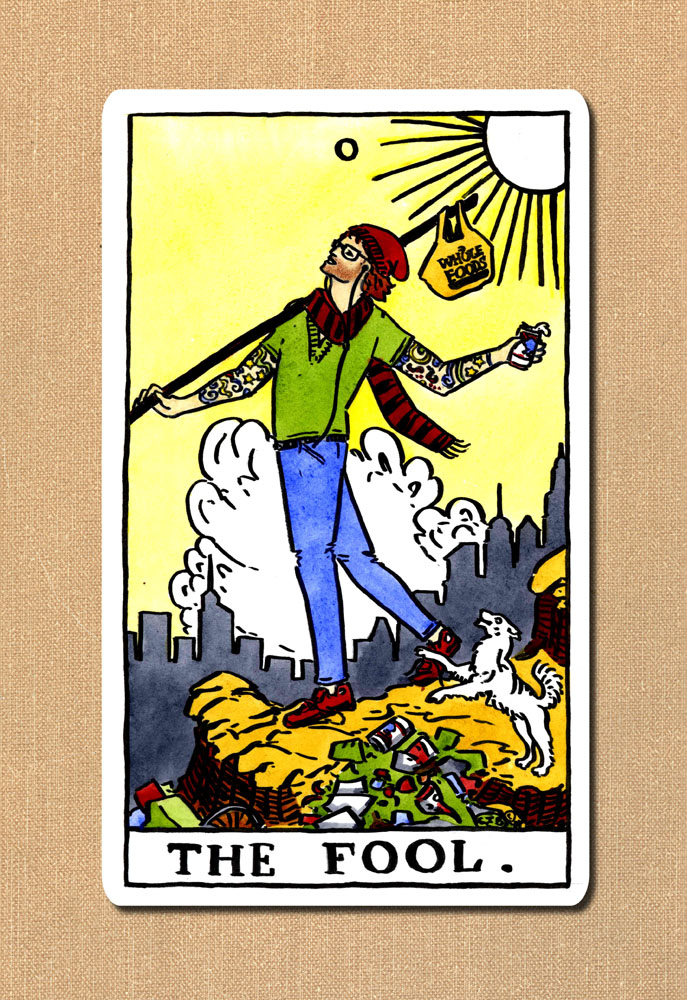
This makes us fools for Christ's sake where others are prudent. It makes us weak where others are strong. While others can be distinguished in faith we find ourselves, again and again, without honor. we exist in the place of the fool, in that naught space that steps foolhardy into the new creation with a beast of destruction both our ever present companion but also forever nipping at our derriere. Our hope and solace is found by being able to not only look back, at the chaos behind us, not only ahead of us, at the looming precipice, but up at the guiding sun that we trust will make some sense of the entire ordeal.
amazing rendition of the fool tarot card from www.nydwyngreendragon.com
           

Tuesday, April 7, 2015

Wedding Cakes Iced in Transgender Oppression

The reality is that right now in the majority of America it is legal to discriminate against the LGBTQ+ community. In most of the country one can readily fire or evict a member of the LGBTQ+ community for no other reason except that characteristic of their being. There are other characteristics, intrinsic ones such as race or sex, and chosen ones, such as religion, that are protected but not sexuality or gender expression. We talk about the issues around the new forms of Religious Freedom Restoration Acts, but what these really do is make the already legal discrimination easier, as the burden of proving that the discrimination should not be allowed is placed on the victim. They also make the fact that such discrimination is legal a known reality, they enfranchise those who otherwise would not realize that they could discriminate.
 
The fight for this has primarily been around providing goods and services to gay weddings, be it cakes, flowers, photography, or in the most recent case of note pizza. The reality is that gay couples are not actually finding it difficult to obtain bakers, florist, photographers, or caterers to provide services for their weddings. They might find set backs and inconveniences, which they should in no way face, and the reality is that any service provider who alleges to provide to the general public should provide to the general public, but the actual fall out from these acts of discrimination are minor. Again, this does not mean they should be ignored or discounted but that they need to be recognized for the small reality, both in scope and numbers, that they are.

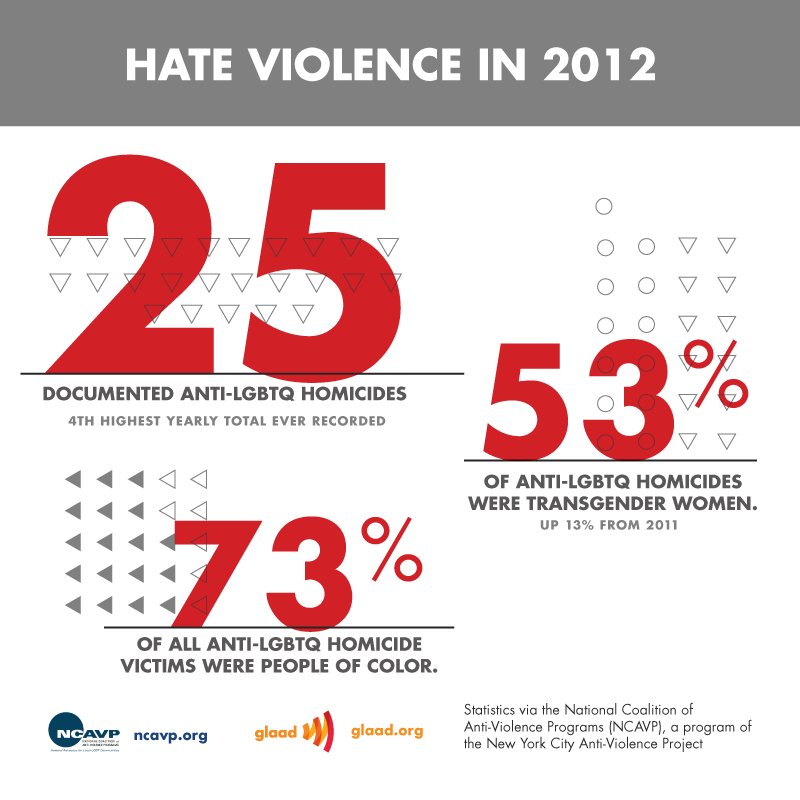
The reality, however, is that the focus on bakers not providing cakes for weddings distracts us from a larger reality, both in scope and numbers, that is predominately ignored. The number of cases, at least where the issue has come to court, of wedding vendors denying services to a same gender couple is, as far as I can tell, under twenty five in the last decade. Each one gets a lot of publicity from both sides and is touted as the reason why we must have various protections, be they for religious groups or the LGBTQ+ community. Compare this, however, to the fact that since 2008 over one hundred transgender individuals have been violently murdered in the United States. Seven transgendered women have been violently murdered since the start of 2015, while there have been no cases filed about wedding vendors failing to provide services to same gender couples in that same time.

I honestly do not understand why the focus of these discussions continues to be around wedding vendors. These acts of discrimination are miniscule in relationship to the violent hate crimes committed against the transgender community. The majority of hate crimes that end in murder against the LGBTQ+ community in America are Transgender Women of Color. More transgender women were murdered in 2012 than reported cases of wedding vendors denying same gender couples services up to that point in American history, a total of about eleven by the end of 2013. The core reality is that hate crimes against our community, specifically targeting the most vulnerable of our members, has been occurring for decades but the non-discrimination ordinances and laws that would send a clear message about the status of LGBTQ+ individuals is for the most part breached in regards to wedding vendors providing services to, by and large, the least vulnerable of our community.

We are now facing a reality where we have marriage equality in states where there are no non-discrimination laws. The effect of this is that those members of the LGBTQ+ community who can readily navigate around discrimination have access to the privileges and responsibilities they need to normalize into the predominant norms of our culture, with the small chance of having to find another wedding vendor. In the midst of this the animosity to passing non-discrimination ordinances and legislation, which in the end always crumbles into nasty rants portraying transgender individuals as sexual predators, is greater than ever. This is the price of how we have engaged LGBTQ+ rights in this country, seeking first the more rarified protections allowed to some by marriage, while placing aside the need for basic protections for all of the community. The west coast and the north east have, for the most part, a functioning reality for the entire community, but those of us in the fly over zone are left in the lurch outside of isolated islands of municipal ordinances. 

Nationally, and in the vast majority of states, our laws tell our citizens that it is perfectly acceptable to discriminate against members of the LGBTQ+ community, even if they can legally marry. This adds to a general milieu that enfranchises hate crimes against the most vulnerable in the community. The horror is that we are struggling to bring about non-discrimination legislation in a way that does not confront the very real harm, and murder, of our members. We are allowing the discussion perpetuate itself in the petty realm of wedding cakes and not confronting the true horror of our society and the tide of transgender blood.


It might be argued that the realm of wedding cakes, no matter how petty, is a palatable realm in which we can get said legislation passed. The reality, however, is that the point of struggles for equality before the law is to confront society with the actual horrors they are perpetuating and to make those abuses of individuals society considers palatable no longer palatable. The goal is to lift up those individuals we now leave destitute to a place of basic recognition; to not only change the law but alter the cultural and societal fabric in which our laws are grounded. If we do not consistently require ourselves, our neighbors, and our legislators to fully confront the horrors they are allowing to perpetuate then we are, in fact, aiding in their perpetuation.